Opinion
How to tell smart glasses from ordinary glasses. Six checkpoints for exam venues
The prohibitions are written into the rules of the major exams. Cases keep surfacing in country after country, yet detection still depends on a proctor's unease. This article sorts the problem into three parts and publishes the identification cues and appraisal criteria.
Smart glasses have become indistinguishable from ordinary glasses. The prohibition wording is in place for the major exams, and cases keep surfacing in country after country. Preparation still lags because the problem sits on the exam floor. I run functional appraisals of consumer smart glasses as Smart Glasses Lab. From that position, I sort the problem into three parts.
- Cases keep surfacing, yet detection depends on a proctor's unease
- There are cues to look for, but the newer the model, the fainter they are
- Preparation is four parts — rules, inspection, training and records — and only the organizers who trained proctors with real devices have made cases stick
1. Cases keep surfacing. Detection always came down to a proctor's unease
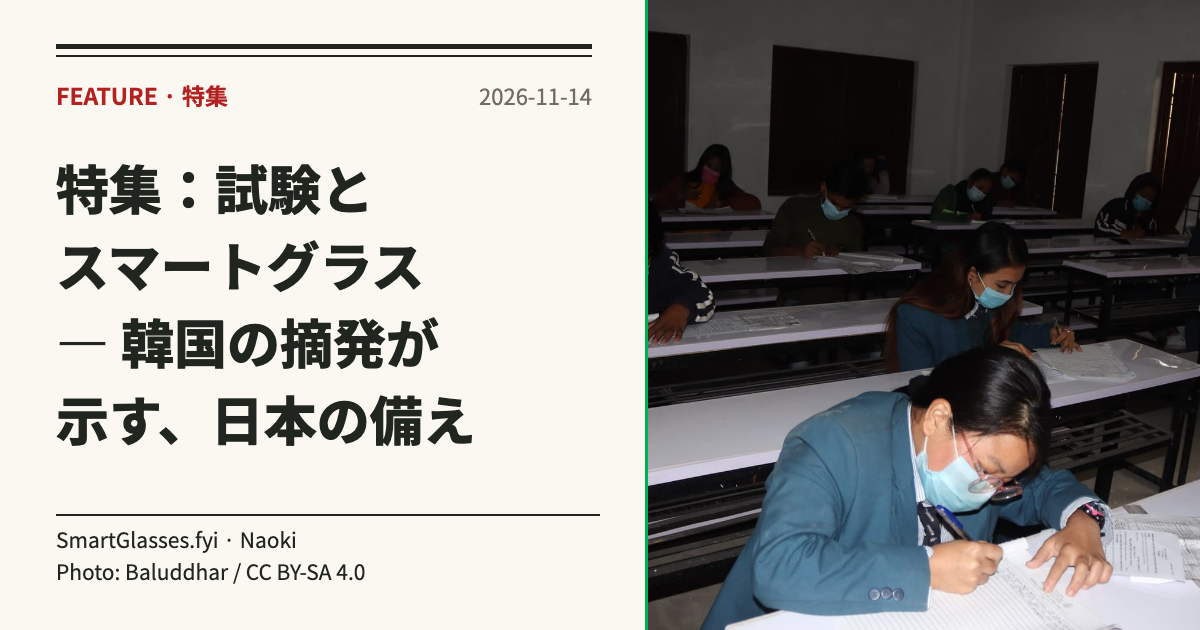
In February 2024, at Waseda University's general entrance examination, a candidate photographed questions with smart glasses and leaked them to social media through a smartphone. The candidate was referred to prosecutors, and the university invalidated all entrance results.
In South Korea in October 2026, cases surfaced one after another in the essay examinations at Yonsei University and the University of Seoul. Both candidates wore ordinary glasses at inspection and swapped them after the exam began. Five cases were caught in national technical qualification exams the same year, and two in TOEIC. The Korean government announced criminal complaints for the national college entrance exam and an extension of the ban period.
At the written examination for the medical and dental schools of National Taiwan University, a proctor checked a candidate who kept looking down for a long time, and the glasses turned out to be hot to the touch. At a driving-license exam in Chengdu, China, a police officer who noticed unnatural behavior caught a combination of camera glasses and a smart ring.
In every case, the decisive factor was the human eye, not detection equipment. Light inside the lens, an indicator lamp on the frame, a sudden electronic sound, heat, behavior. Whether a case is caught depends on whether the proctor on the spot can sense that something is off.
2. There are six cues. The newer the model, the fainter they get
There are six points to check.
- Temple thickness and shape. Housing a battery and circuit board, temples tend to be thicker and straighter than ordinary glasses
- Camera lens position. A small lens at the front edge or near the nose pad can catch the light and stand out
- Recording indicator LED. Many models light an LED while recording; the color and position are fixed per model
- Charging contacts. Contacts on the inner temple or near the hinge do not exist on ordinary glasses
- Speaker holes. Small holes toward the rear of the temple identify models that are not bone-conduction
- Weight. Many models are clearly heavier than ordinary prescription glasses; the difference is obvious in hand
The problem is that more models are arriving with fainter cues. Audio-focused models without a camera look almost exactly like ordinary glasses, and some models have no LED. These six points are a first screening for deciding whether to ask for a closer check on the floor; confirming the functions takes an appraisal based on the actual device and its specification documents.
3. Preparation has four parts. Rule wording alone does not move the floor
The Reiwa 8 (2026) Guide for Examinees for the Common Test lists 'wearable devices (such as smartwatches and smart glasses)' among the prohibited electronic devices, and states that if the device is not stored in a bag it counts as cheating even when switched off. The wording is already in place.
What organizers should prepare falls into four points.
- Rule wording. Name 'smart glasses' as a category, and set the standard on possession and wearing, not on whether the power is on
- Cooperation with inspection, and handling of refusals. Decide in advance the basis on which a proctor may ask to inspect glasses, and what happens when a candidate does not comply
- Proctor training. Prepare real devices and share the identification points and the spread of models before the exam season
- Recording and preserving incidents. Record the time, circumstances and condition of the device when found, in a form that lets the determination happen later
The weight of the third point is shown by the Korean case. The University of Seoul had bought actual devices ahead of its exam and trained its proctors. The case was caught because that preparation existed.
A line has to be drawn at the same time. Treatment of candidates who use prescription glasses or who need a device is designed together with an advance-application framework, the way the Common Test handles requests for accommodations.
The appraisal criteria are published in three classes, A, B and C
The risk of each model is set by its combination of functions. I publish the classes I use in appraisals. A class is a technical finding about a device's functions; whether cheating occurred, and any sanction, is for the organizer to decide.
| Class | Conditions | Indicative handling in exams |
|---|---|---|
| A: High risk | Has a camera and external transmission, or can generate answers with a camera and AI | Bringing it in should not be allowed |
| B: Medium risk | Has a display and communication but no camera, or has recording and communication | Bringing it in should not be allowed (information can be displayed and outside contact is possible) |
| C: Low risk | Recording only, with no communication or other way to interact with the outside | At the organizer's judgment. Declared use, or storage with the power off, can be handled operationally |
In an appraisal, I check the presence and position of a camera, the presence and type of display, communication functions, AI functions, recording and connection to external devices, and the external identification points, and state the class and its grounds in writing for each device.
Enquiries are accepted from exam organizers and organizations
Enquiries are handled through Smart Glasses Lab. For exam organizers and operating organizations, I take consultations on device appraisal and on identification training for exam proctors. Fees are quoted individually according to the work. Contact: [email protected] . Case write-ups from Japan and overseas, and the education and training built on them, are summarized on the Smart Glasses Lab page.