
Opinion
Why I believe in the future of AI glasses
Why do smart glasses make me excited about the future? I explore expanded vision and my hopes for glasses that fit naturally into everyday life.
First published:note · This article and photos are reprinted from note.
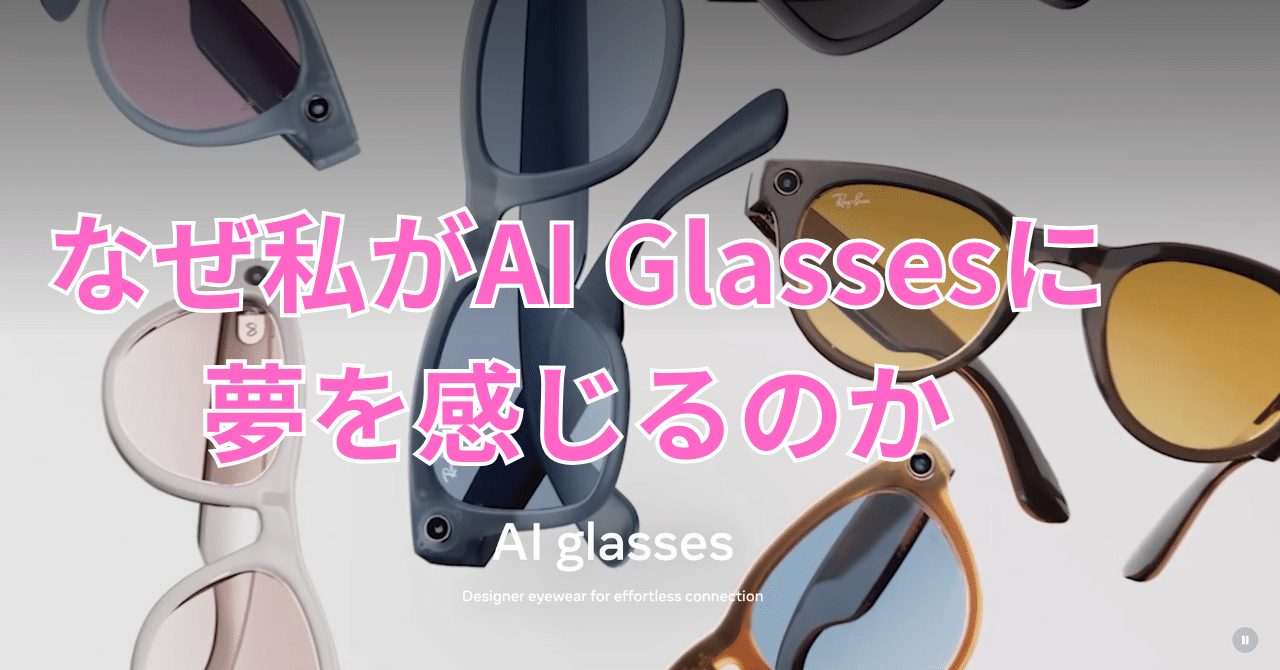
Every morning when I wake up, I feel a strong desire for a future that is yet to come.
Thoughts on human limits and possibilities
Think about it. Even though we are living in 2025, we are still holding smartphones and tapping the screen. It's still tangled in the earphone cord (even though it's wireless, I forget the case and it's frustrating). I'm still confused and can't remember, "Oh, what was that person's name?"
But isn't this an opportunity?
Humans have five senses. Vision, hearing, touch, taste, smell. However, almost all of what we call "information" is text, images, and audio. Can you get a feel for stock prices by taste? Can you understand the content of emails by smell? Can you read your Twitter timeline with your sense of touch?
I can't do it yet. However, there is still room for updates to our hardware.
Taste, smell, and touch have too low resolution to cope with modern information density. Our biological interfaces are still the same as they were in the hunter-gatherer era. If anything, the resolution has deteriorated.
A ray of hope for hearing expansion
But wait. How's your hearing?
When I calculated the amount of time I wore AirPods, it was over 12 hours a day. Whether I'm walking outside, working, or at the gym, I'm always listening to something. You can also pick up real-world sounds while listening to podcasts. You can also make phone calls while playing music. You can also hear car sounds while talking to Siri.
Is this an expansion?
Thanks to the pass-through function, my hearing has improved to its original ability. I can hear the sound of cars, and Spotify is playing at the same time. You can hear your friend's voice, and you can also hear GPT's voice response at the same time.
With AirPods, the sense of hearing is no longer that of a real person. It's a cyborg's hearing.
And I can't go back to this. You know that feeling of despair the day you forget your AirPods? Real-world sounds alone are not enough. I'm addicted to information
Desperation and desire for visual expansion
So what about vision? What is the sensory organ through which humans acquire the most information?
Let's think about smartphones. Smartphones are certainly a great invention, but they are not an extension. It's an alternative. While I'm looking at my smartphone, I can't see the real world. The reason you bump into people with smartphones while walking is because you are deprived of your vision. This is not a true visual enhancement.
What about VR? Vision Pro's pass-through feature is certainly revolutionary. Digital information is also displayed while viewing the real world. However, there are still issues with daily use in terms of weight, price, and social acceptability. It's heavy to begin with.
We need visual augmentation. Just like hearing, I want visual information from the real world plus α. You can see the reality in front of you, and at the same time, you can also see the navigation on Google Maps. While you can still see your friend's face, you can also see their latest Instagram posts.
However, the reality is that there is still no product that achieves this.
No, to be exact, there are "almost" none.
The line between fake and real
So what comes next? I already know. This is a fusion of reality and digital through a glasses-type device.
Invisible glasses are not AI Glasses
Let me be clear first. I don't want to recognize glasses-type devices that cannot see text as AI Glasses.
After all, if you can't see, you'll need glasses with a camera and earphones. That's not AI "Glasses", is it? It's just a glasses type.
The essence of glasses is ``extension of vision.'' Allows nearsighted people to see far away. Allows people with presbyopia to see up close. The essence of glasses is to make things visible that could not be seen.
A device with only a voice assistant and a camera is simply a wearable camera-equipped earphone placed on a glasses frame. If you don't use the glass part, it's just fancy glasses. It's not glasses.
Current status of the smart glasses market
Now in 2025, there are an overwhelming number of "smart glasses" on the market. But most of them are not AI Glasses. Let's sort it out once.
Category 1: Fashionable glasses with camera and microphone
Unfortunately, these aren't "AI Glasses". Because it completely ignores the essence of glasses, which is ``visual expansion''.
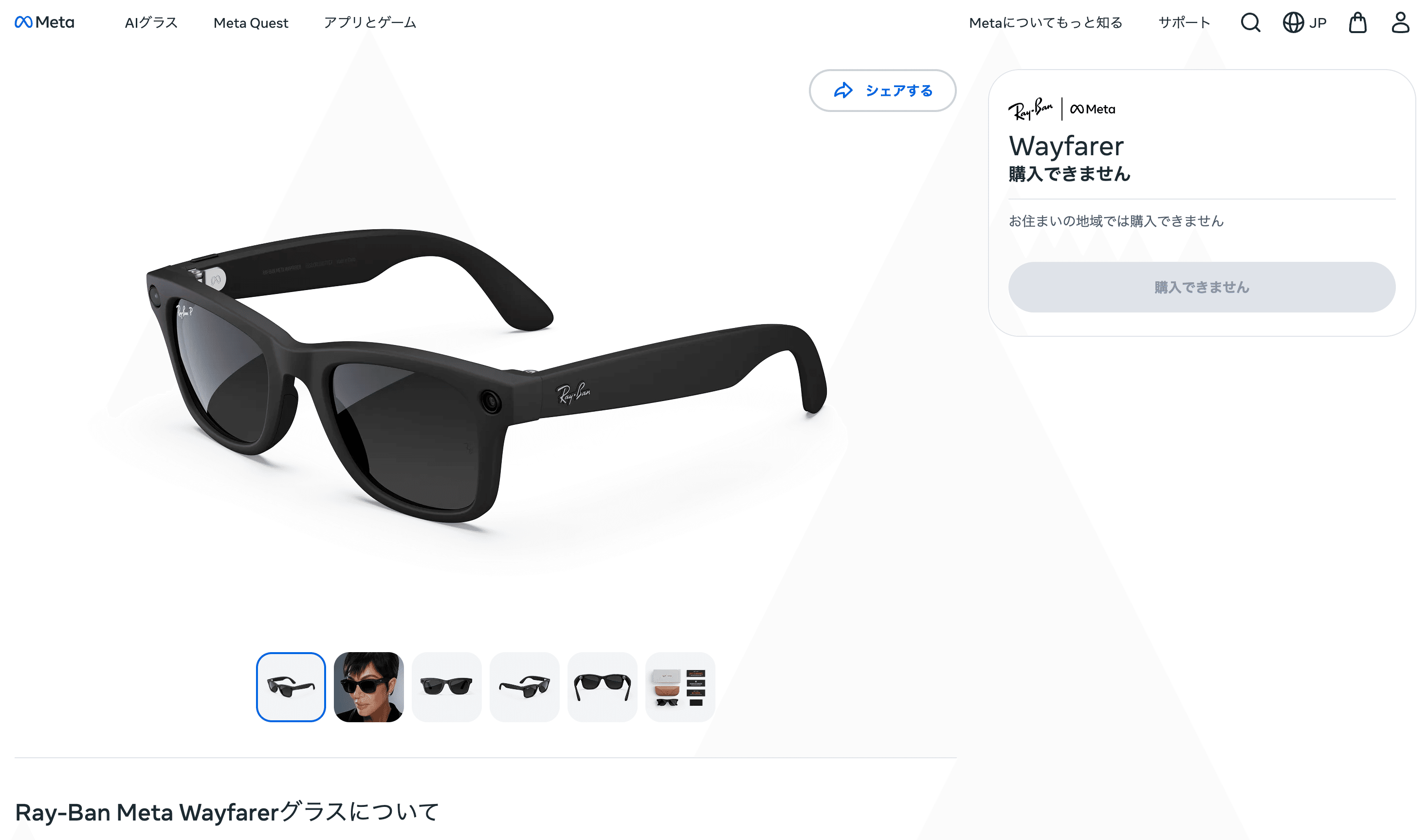
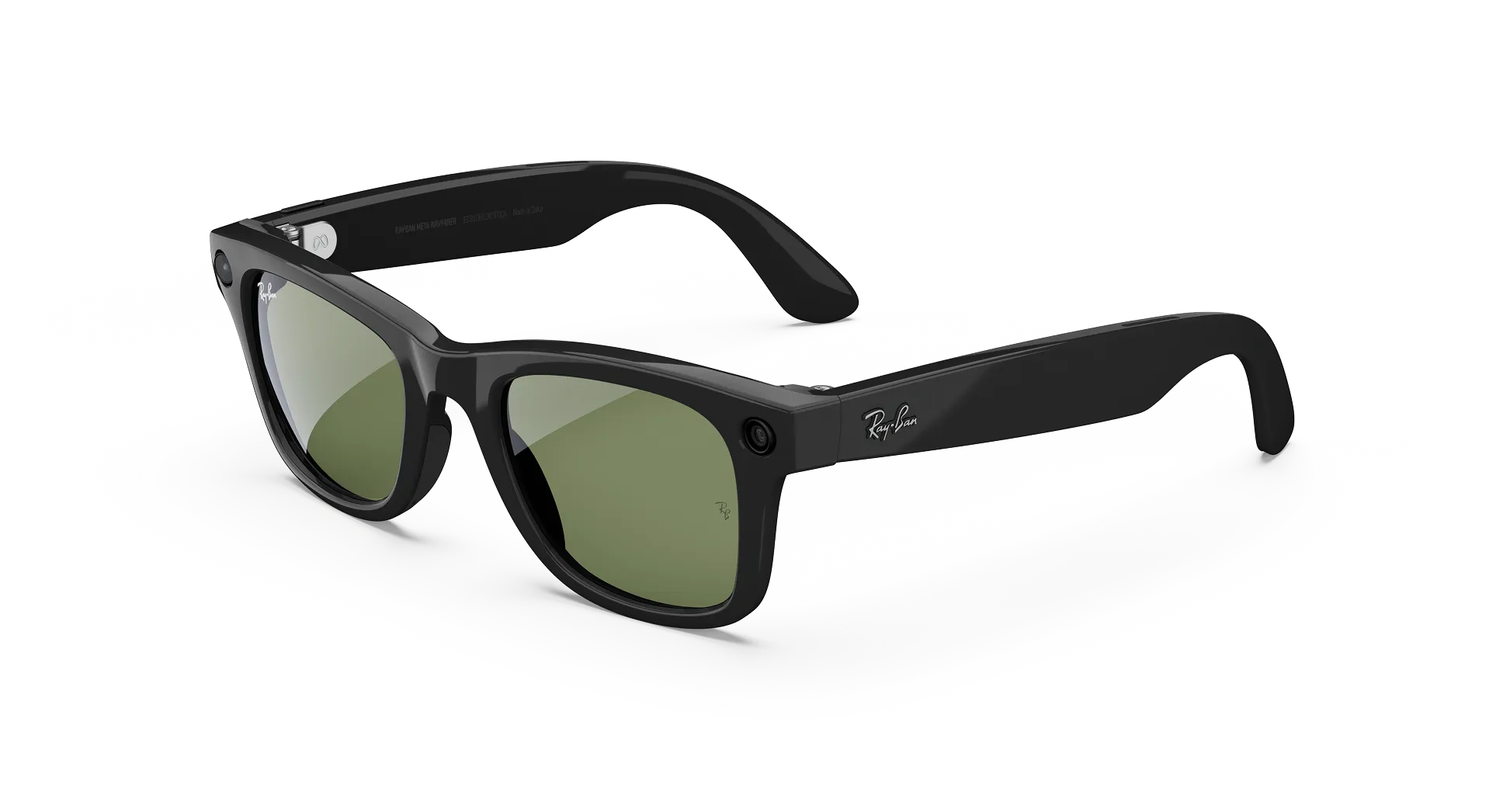
Ray-Ban Meta Smart Glasses (approximately 43,000 yen to 54,000 yen)
-
Equipped with 12MP camera
-
Meta AI voice assistant
-
Built-in speaker
-
Display: None❌
The world's best-selling "smart glasses". However, these are just "fashionable glasses with a camera and microphone." If you talk to Meta AI, it will respond, but you can only hear the answer by voice. There is no visual enhancement.
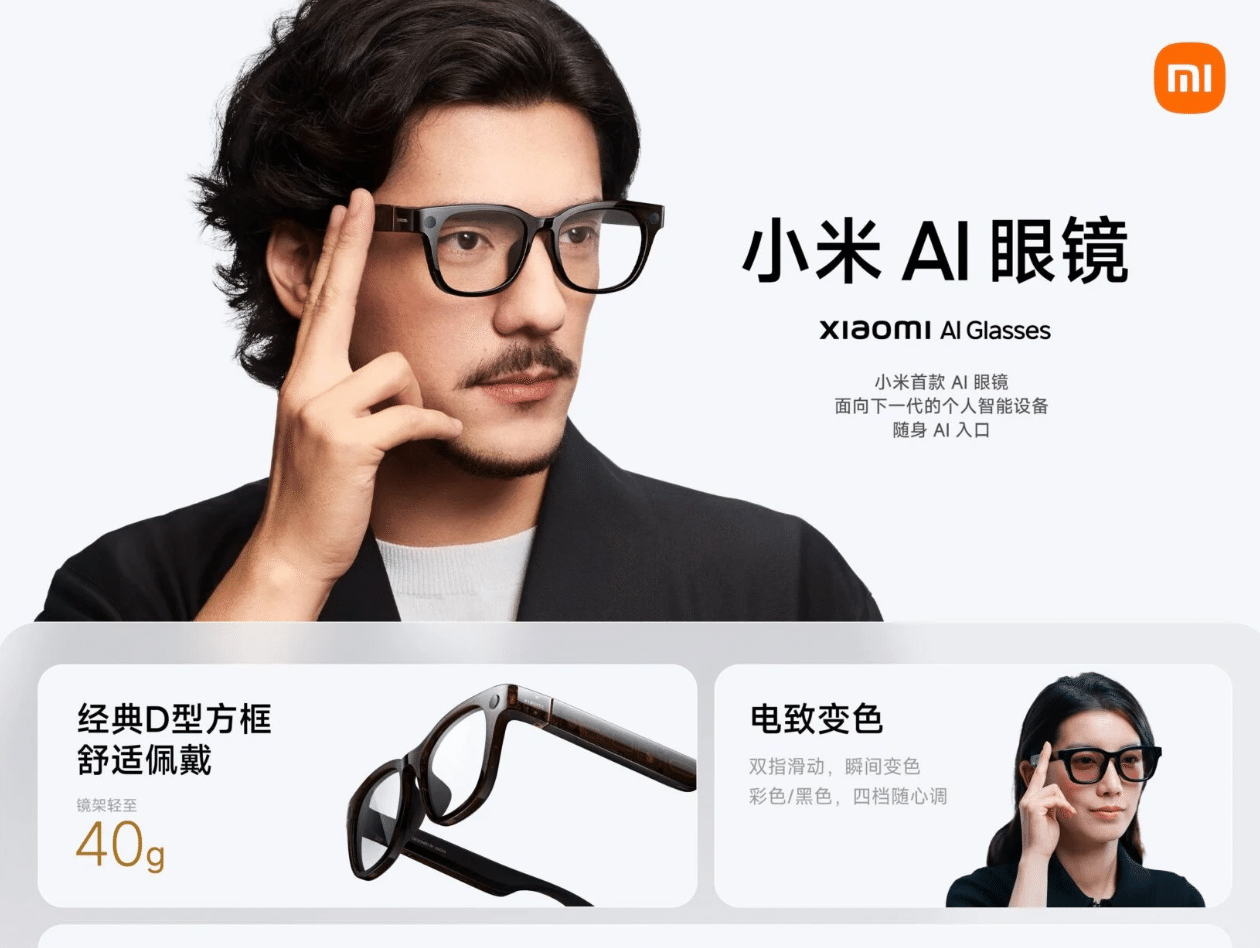
Xiaomi AI Glasses (approx. 40,000 yen)
-
Equipped with 12MP camera
-
Electrochromic lens (automatic light control)
-
8.6 hours battery
-
Display: None❌
A Chinese-made device packed with the latest technology. Electrochromic lenses are futuristic, but in the end they are nothing more than "high-performance sunglasses." Well, it was just released the other day, so expectations are very high. What's better than the Ray-Ban Meta is that it still has functionality in the glass part.
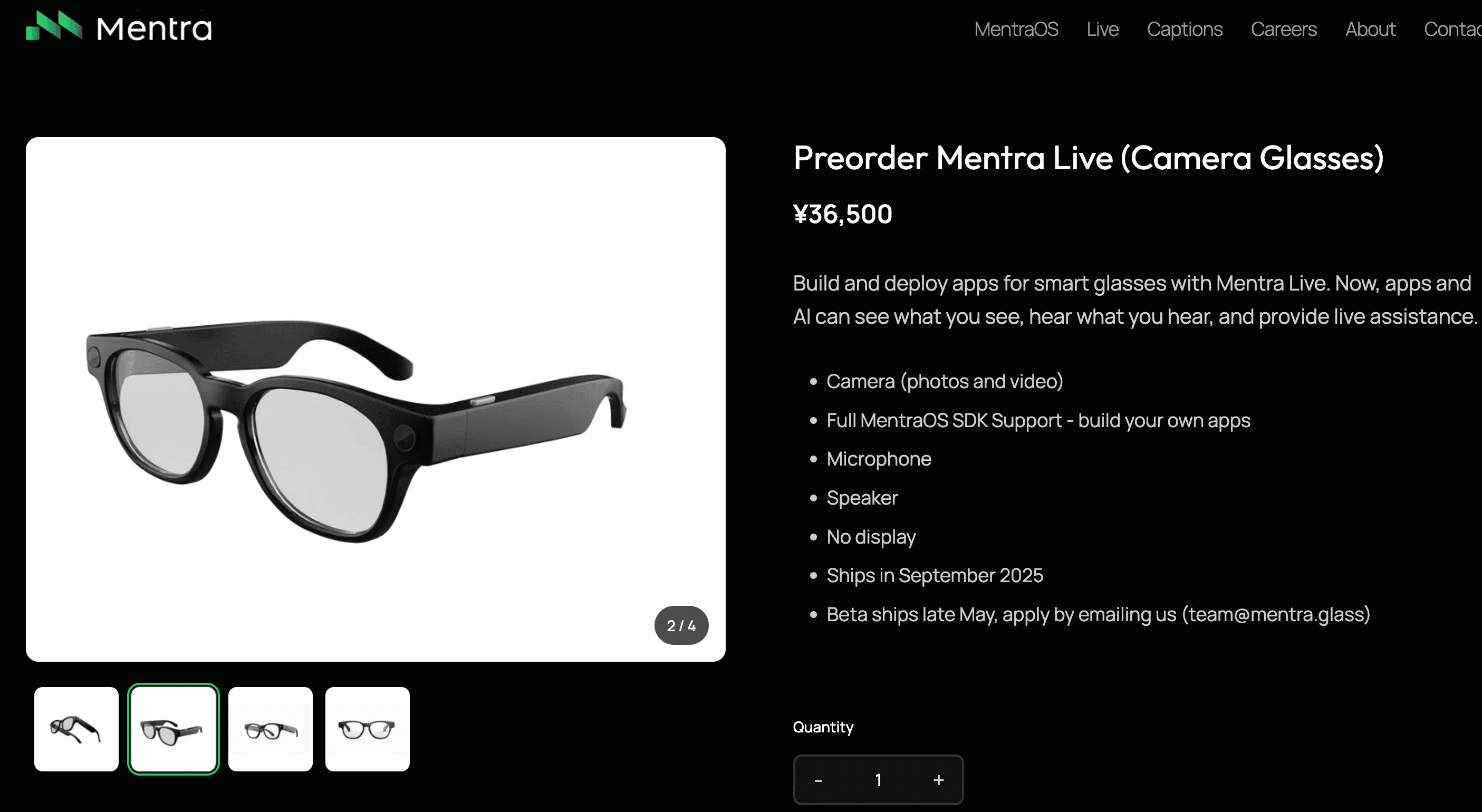
Mentra Live (approximately 36,000 yen, scheduled to be released in September 2025)
-
Equipped with voice assistant
-
lightweight design
-
Display: None❌
The price is attractive, but it just adds another ``fashionable glasses with camera and microphone''. Of course, it is attractive because it is made by an OS company such as Mentra OS that will lead future glasses-type devices. But it's not the future yet.
These are simply earphones with wearable cameras mounted on glasses frames. If you don't use the glass part, it's the same as fancy glasses.
Category 2: True visual enhancement device
Now comes the main point. True AI Glasses are really rare.
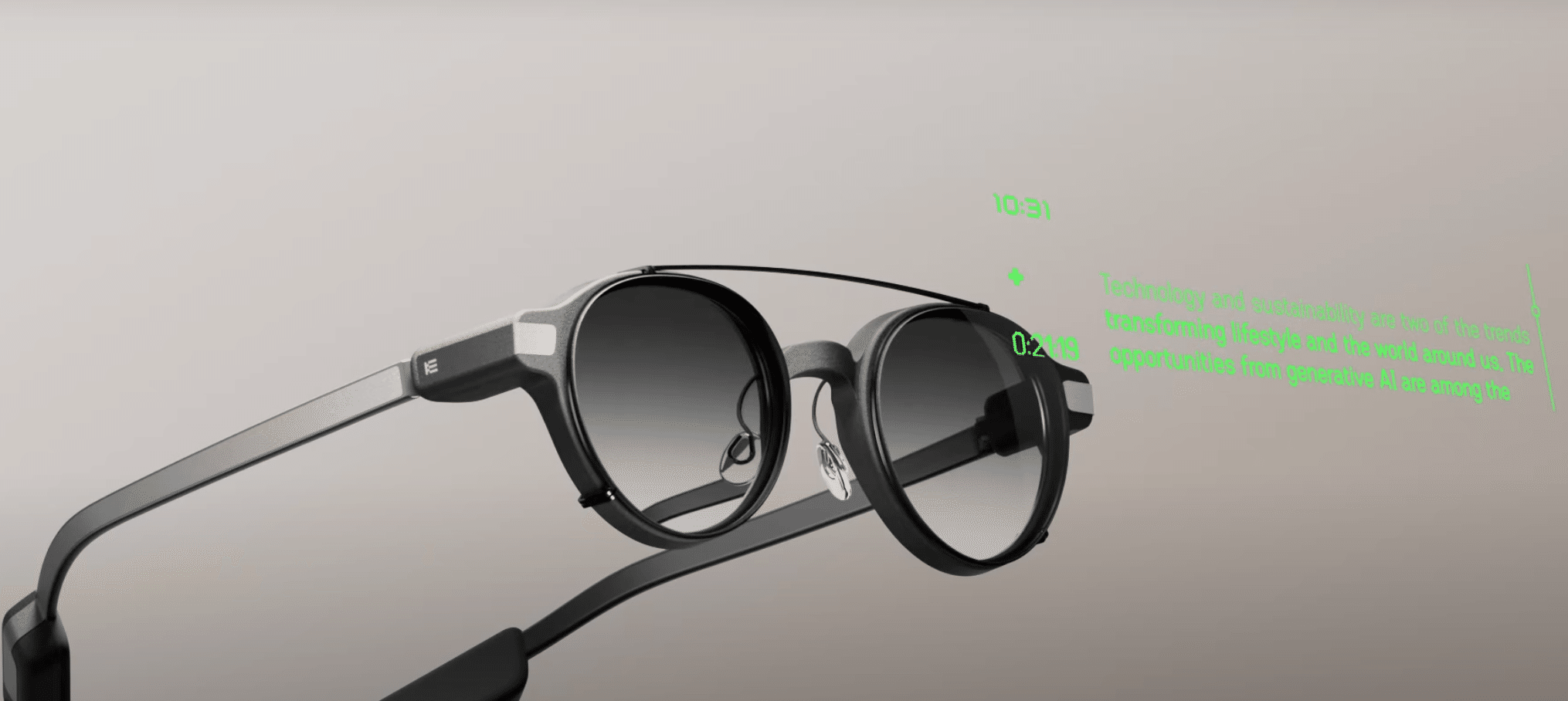
Even G1 (approx. 86,000 yen)
-
MicroLED optical engine
-
640×480 resolution
-
AR display: Yes ✅ (green single color)
I think this is the closest future. This is because this is what achieves vision+α.
MicroLED optical engine projects information directly into the real world. Although the display is in a single color of green and the resolution is modest at 640 x 480, the text still appears to be floating in the real world.

-
The time is always displayed at the edge of your vision
-
Google Maps navigation arrows overlap real roads
-
message notification floating in the air
-
You can refer to documentation while programming
It's still the first generation and in its rough stages. But this is definitely the next step for humanity.
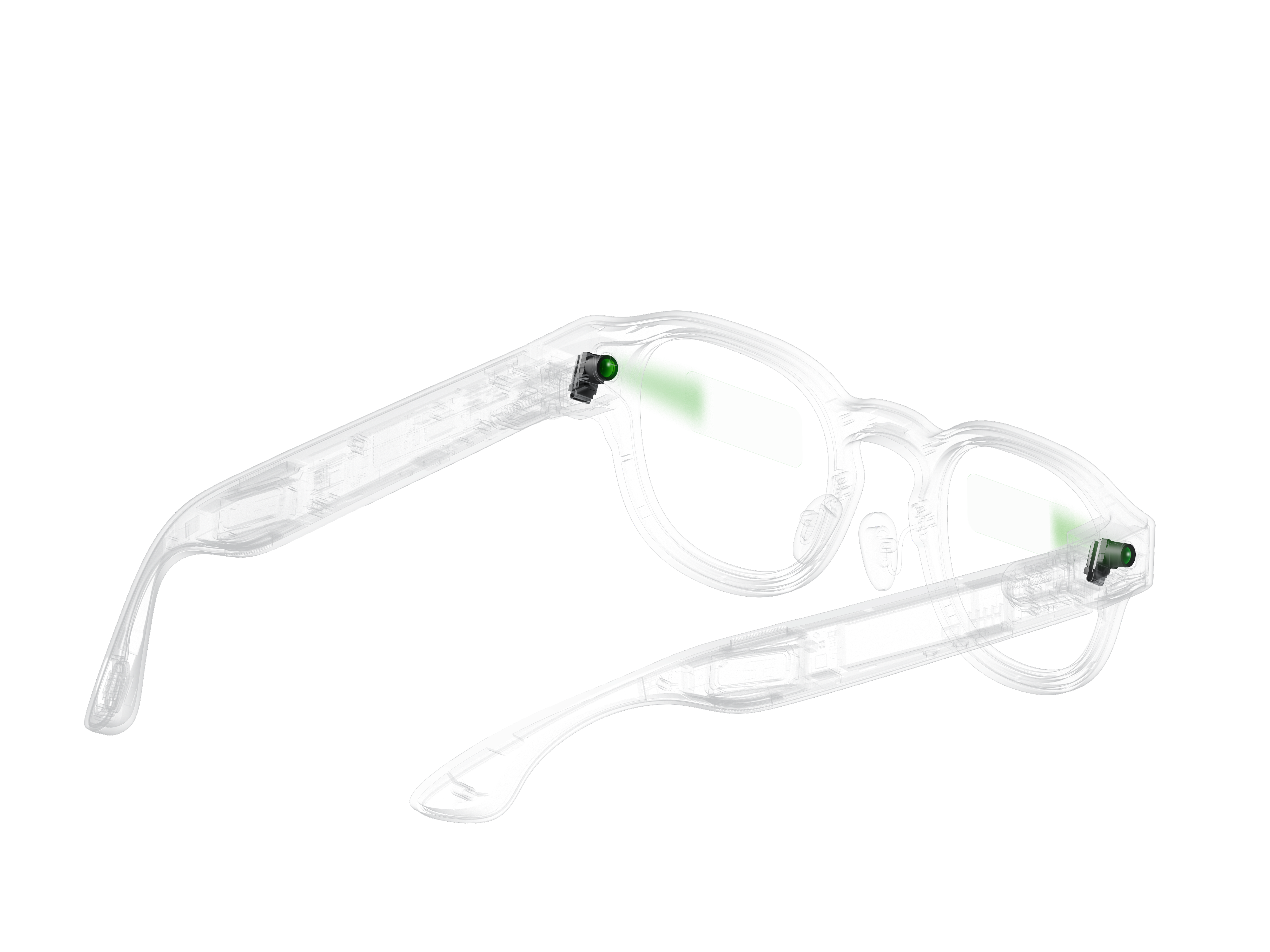
Halliday (approx. 57,000 yen)

-
transparent display technology
-
Information overlay to the real world
-
discreet design
-
AR display: Yes✅
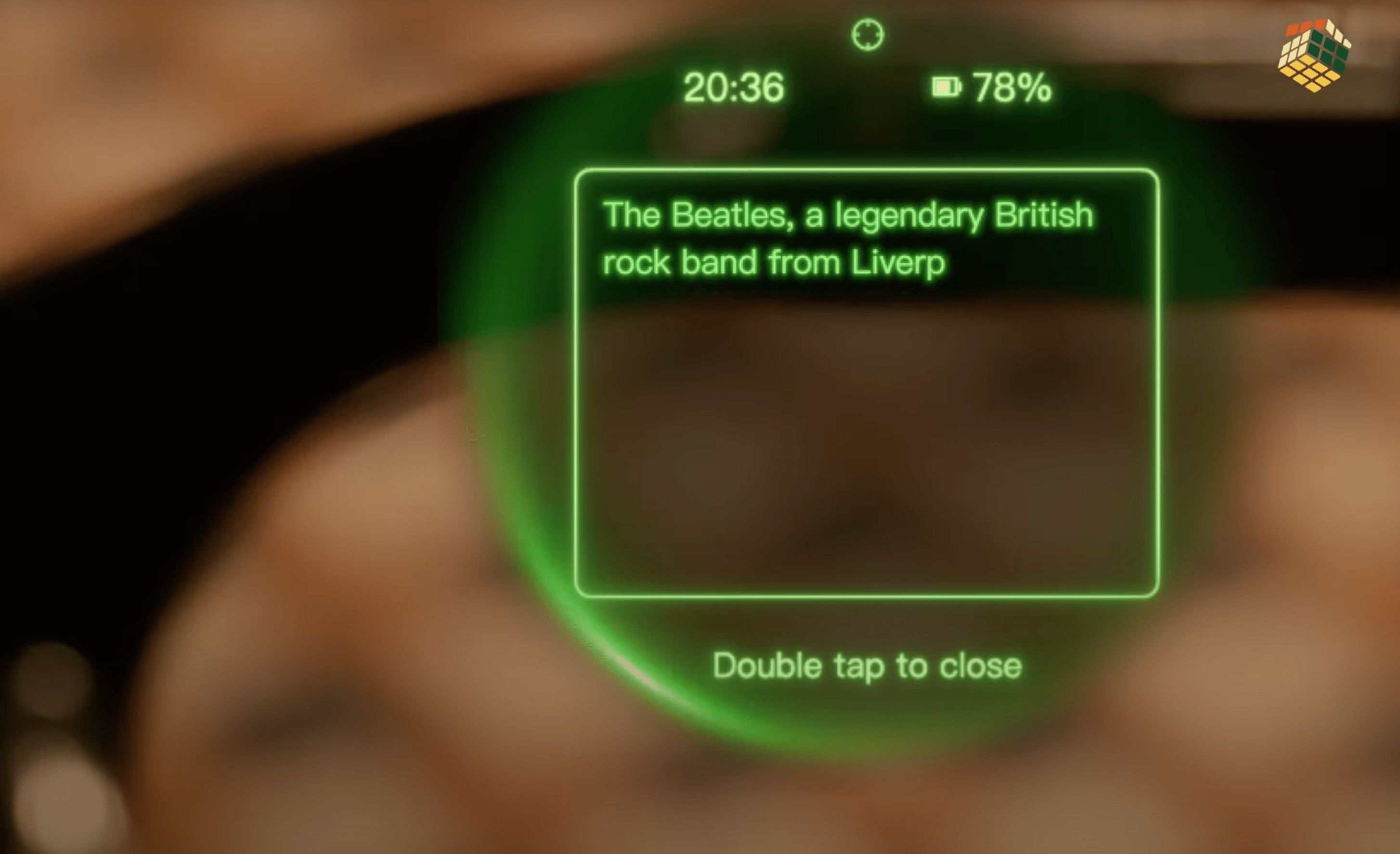
This should have appeared at this year's CES, but there has been no follow-up news. Even G1 projects onto the glass, but Halliday projects directly onto the eyeball. Although there are some concerns about the effects it may have on living organisms, it is showing promise for the future.
Like the Even G1, it can display information superimposed on the real world. The price is relatively reasonable, and the design is sophisticated.
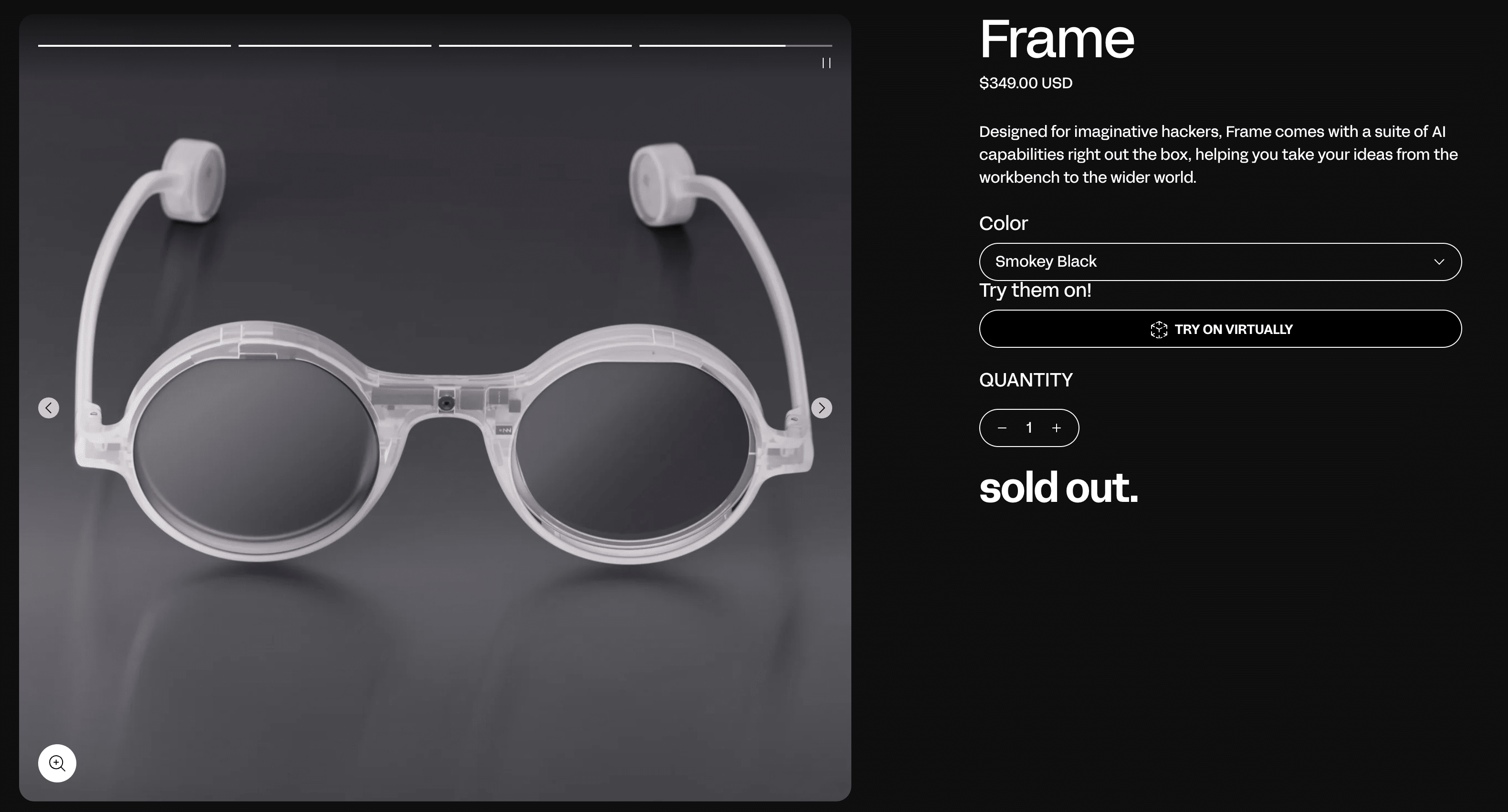
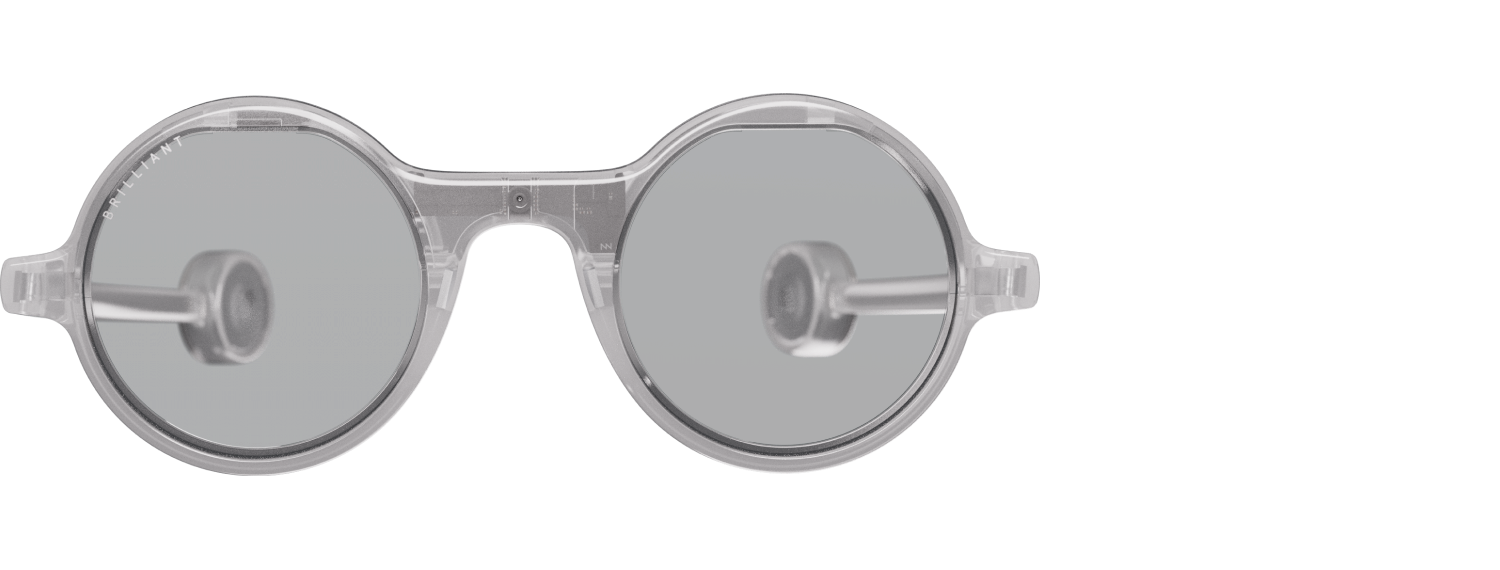
Frame (approx. 51,000 yen)
-
open source platform
-
AR display: Yes ✅ (green single color)
The appeal is that it is completely OSS, including devices. I've actually tried it, but the problem is that it can only display about one line, but it's clearly an approach to the future.
Also, the ease with which the device focuses is quite variable and differs depending on the lot. In that sense, it is still far from complete.
Why are projection devices the only real thing?
"Wouldn't it be okay to use the Apple Watch for just notifications and navigation?"
There's certainly not much you can do now. But what's important is what you can do? After all, you can't see Apple Twach unless you look at the screen (obviously).
Revolutionary features of projection devices:
-
Hands-free information access: while walking, working, and talking
-
Contextual information display: Immediately display information related to what you're looking at.
-
True multitasking: experience the real and digital worlds simultaneously
-
Augmenting human abilities: Enhancement of memory, language, and cognition
You can't do it with glasses that can't see. With just audio, the information is sparse, and with just a camera, it's a one-way street.
Humans are visual creatures. ThereforeSmart glasses that do not extend vision are not smart glasses, they are just cameras with smart earphones... It's
The world I want to see in 2030
When you wake up in the morning, you put on the glasses-type device. Then, today's schedule appears in the corner of my vision. You can also see the weather forecast. You can also see stock prices. But the real world remains as it appears.
When you look at a signboard at a station, automatically translated characters are displayed overlapping each other.
During a meeting, display the manuscript on a teleprompter while listening to the other party. AI summarizes the main points from your voice in real time. There's no need to take notes.
When looking at a restaurant menu, calorie information, allergy information, and reviews appear to overlap. The photos of the food also seem to be floating in my mind.
This is it, this is the year 2030 I want to see.
Of course, there is Neurolink beyond that. A brain-computer interface developed by Elon Musk. A technology that allows a chip to be implanted directly into the brain to operate a computer just by thinking. Trials are already scheduled to begin in 2025 on 20-30 patients.
But Neurolink requires surgery. A hole is drilled into the skull and a chip is implanted into the brain. The risks are high, and social acceptance takes time. The non-invasive revolution is coming first.
ThereforeThe next step is definitely glasses.
This will likely be followed by contact lens-type devices, retinal projection technology, and finally Neurolink. However, there are many issues to be solved, including battery technology, materials science, and biocompatibility. It will still take 10-20 years.
Why are you so excited?
I'm sure. Next time I'll definitely wear glasses.
Humanity is hitting the wall of biological limits. The brain's processing capacity is limited. Storage capacity is also limited. The reaction rate is also finite. But technological progress is exponential.
It's dangerous if it continues like this. Humans are seriously being left behind by technology.
But it's different if you have a glasses-type device. Memory becomes limitless. Computing power will be equivalent to that of a computer. Language barriers will also disappear. The gap in knowledge will also disappear.
The best thing about glasses is how they are made.
I am severely nearsighted. If I remove it, I can't even read the text. A while ago, it would have been called a disability, but nowadays, with glasses, it is no longer inferior. In other words, glasses have lowered the normal reference point. I think this is because I can now always receive the assistance of glasses.
There may be many reasons why people have weak memory or thinking skills, but in an era where AI has come as commonplace as wearing glasses, the standard for being ``inferior'' will be lowered. This is because it is common to wear them, and people will only be evaluated if those specifications are included.
nobody thereDon't say, "I'm sneaky because I wear glasses.".. Because it permeated.
And it's good to wear glasses.
Taking advantage of this lowered standard, we are further expanding our normal range.
-
Social acceptability:
Glasses are already integrated into society. no one feels uncomfortable -
Can be worn at all times:
There is no need to take it out of your pocket like you do with a smartphone. Always have access to information -
True Augmented Reality:
While looking at the real world, you can also see digital information at the same time. Visual +α -
Technical feasibility:
Lighter than VR, safer than Neurolink, more convenient than Apple Watch
Among the five human senses, auditory expansion has already been achieved with earphones. Our sense of hearing has already become cyborg.
Now it's the turn of visual augmentation.
And I want to be a witness to that future. No, I want to be a participant.
That's why I choose a projection device. Invisible glasses are just accessories. True AI Glasses must augment vision.
In 2025, we are at the most important inflection point in human history. We are on the verge of a transformation that is unprecedented, or even greater, than ever since smartphones were introduced in 2007.
We can't afford to miss this wave.
That's why I bought the Even G1. That's why I use it every day. That's why I get excited every time new projection smart glasses are announced.
Even if an invisible glasses-type device is announced, my heart won't be excited. It's just an earphone with a camera.
This isn't just a gadget. It's human evolution.
And I want to be at the forefront of that evolution.
Why projection devices are the future
I'm sure. Projection-type devices are true AI Glasses.
A device that only has a camera and earphones looks like glasses, but does not understand the true nature of glasses. Glasses are a tool that expands your vision. Allows nearsighted people to see far away. Allows people with presbyopia to see up close. Next-generation glasses will make digital information visible.
Why projection devices are better:
-
True augmentation of vision: See digital information while looking at the real world
-
Intrinsic value of glasses: making the invisible visible
-
Achieving always-on connectivity: Accessing information without using your hands
-
The right direction for evolution: Just as hearing was enhanced with earphones, vision can be enhanced with glasses.
Invisible glasses are just a temporary product after all. Companies that can see the future are creating projection technology properly. I want Xiaomi and Meta to be more challenging. Big Tech should invest capital and start a revolution.
Projection devices like the Even G1 and Halliday are still in their first generation and in the rough stages. But they're heading in the right direction. We understand the original mission of glasses: to expand vision.
That's why I recommend projection devices. Invisible glasses can only be called glasses-type.
That's why I dream of glasses devices.
Products featured in this article
Compare products in this article →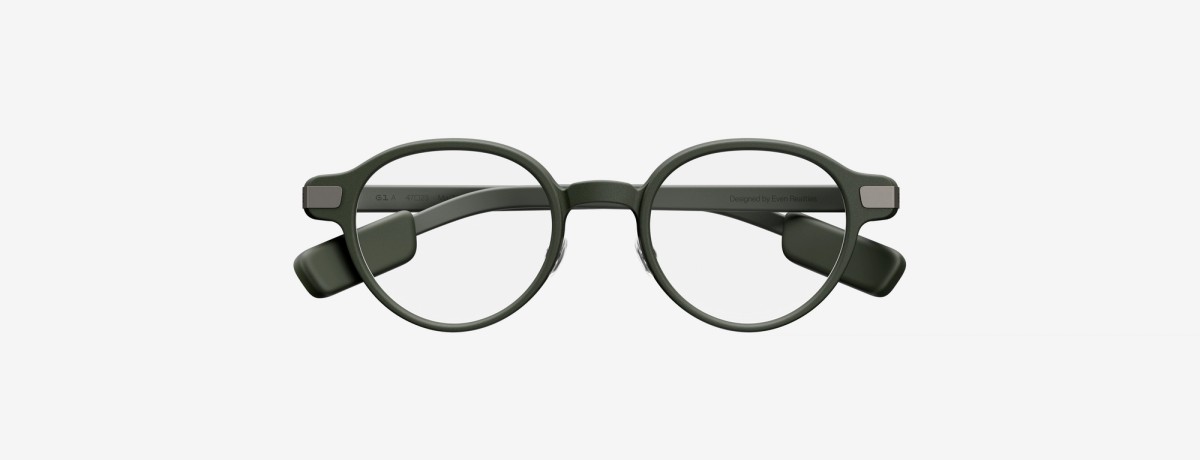 Even G1 ASpecifications, prices, and related articles →
 Even G1 BSpecifications, prices, and related articles →
 Halliday DigiWindowSpecifications, prices, and related articles →
 Brilliant Labs FrameSpecifications, prices, and related articles →
 Ray-Ban Meta WayfarerSpecifications, prices, and related articles →
 Xiaomi AI GlassesSpecifications, prices, and related articles →