Opinion
Smart-glasses cheating in exams, always spotted by human eyes. Dedicated inspectors at all 1,312 CSAT venues in South Korea
Waseda, universities and schools in South Korea, Taiwan, China. Smart-glasses cheating cases have surfaced one after another across these countries, but the decisive factor in detection was never a device. This article takes stock of where Japan's exam organizers stand, using South Korea's choice for the Suneung — stationing people who can tell the difference — as the reference point.
This autumn, cases involving exams and smart glasses came together all at once across countries: university entrance exams and school record exams in South Korea, medical and dental school entrance exams in Taiwan, and university and driving license exams in China. Lined up side by side, the decisive factor in detection was never a detection device. It was always the eyes of proctors and teachers. South Korea changed how it builds its countermeasures to match that reality — not by adding more prohibition wording, but by stationing people who can tell the difference. Placed next to Japan's preparations, the difference comes into view.
Detection never once came down to a device
In February 2024, at Waseda University's general entrance exam, a candidate photographed questions with smart glasses and leaked them to social media via a smartphone. The candidate was referred to prosecutors, and the university invalidated all of that year's entrance results. In South Korea in October 2026, detections followed one after another at essay exams at Yonsei University and the University of Seoul. Both candidates wore ordinary glasses at the check, then switched to smart glasses after the exam began. The same month brought five cases in national technical qualification exams and two in TOEIC.
At National Taiwan University's written exams for its medical and dental schools, a proctor checked a candidate who kept looking down for a long time, and the glasses turned out to be generating heat. In a driver's license exam in Chengdu, China, a police officer who noticed unnatural behavior caught a combination of camera-equipped glasses and a smart ring. At a Chinese university exam, cheating that photographed questions and displayed answers on the lens was reported, and inspections of glasses have also been introduced.
The four cases found in Korean school exams had even more concrete tells: a hand repeatedly touching the frame, a green light reflected in the glasses, and glasses the student did not normally wear. In every case, what separated detection from oversight was not detection technology, but knowing what to look for.
Korea's answer was to station 1,312 people who can tell the difference
What South Korea's Ministry of Education prepared for the Suneung (College Scholastic Ability Test) on November 19 was not another line of prohibitions. It was stationing smart glasses identification officers at all 1,312 test sites nationwide. Judgment runs in three stages. When a proctor in the room finds suspicious glasses, the check moves to the site's officer. If the officer also cannot decide, situation rooms at the provincial education office, and then the Ministry of Education and the Korea Institute for Curriculum and Evaluation, confirm by photo and video. The design does not settle the question on the spot. Officers receive hands-on training with real devices beforehand, and South Gyeongsang Province holds a real-device confirmation training on November 17, just before the exam.
Penalties were strengthened at the same time. Cheating draws a criminal referral, and the exam ban lengthens from one year to three. But what changes behavior on the ground is the checking system more than the weight of the penalty. Korea dropped the design in which a single proctor carries the conclusion alone, and stationed people at every test site to whom uncertain cases can be escalated. The unit of countermeasures moved from the clauses of the rules to people.
Why schools could spot it cannot be used at large-scale exams
The 'glasses they do not normally wear' tell that worked in the four school-exam cases worked because teachers know their students day to day. Turn that around: at university entrance exams and national qualification exams, where candidates and proctors are strangers, that sense of wrongness is not available as material. The remaining tells are only the hand touching the frame, the light, and the identification points of the model itself.
And some models produce no clue at all. Audio-only models without a camera look no different from ordinary glasses at the lens. Models without a display emit no light. With types that are extremely difficult to tell apart, there are limits to settling the question by eyesight alone on site. How to check, how to record, and where to escalate a doubtful case — whether the procedure side is decided in advance affects how the site can judge.
Suspicion has started to reach ordinary glasses
When a venue lacks the ability to tell the difference and only strengthens countermeasures, suspicion flows toward the wider side. At the University of Patras in Greece, wearing glasses during exams requires a doctor's certificate. In Japan, too, the framing in which even ordinary glasses fall under suspicion has become a topic of discussion.
Prescription glasses are a necessity for many candidates. Operations that suspect everyone shift the burden onto candidates who are not using smart glasses. South Korea's officer deployment takes the order of raising identification accuracy before widening the scope of suspicion.
What remains in Japan's preparations is the stationing of people, not the wording
Japan's Common Test already states a ban on wearable devices in the Reiwa 8 (2026) exam guide. The wording is in place. When I organized what organizers should prepare into four points — regulations, checks, training, and records — I wrote that the third, training, carries the most weight. This autumn, Korea carried out that training, paired with stationing officers, at national scale.
What Japan has not yet put together is three things: training with real devices, a place to escalate when in doubt, and records of what was found. The line of prohibition is already written. What remains is stationing people.
That preparation can be built in Japan, too
What supports the Korean system in practice is the judgment flow and identification manual that keep officers from hesitating on site: which glasses to check, what to look at during a check, and where and how to escalate when a judgment is difficult. How the site moves on the day depends on how concretely that document is written.
Smart Glasses Lab provides this part for Japan.
- Identification manual preparation: we document, for each model, the identifying features (camera position, LED, charging port, weight, and so on), the criteria for requesting a check, and the escalation procedure for hard-to-judge cases, matched to the organizer's rules and operations
- Identification training for exam invigilators: a 90-minute training session with real devices brought in, where participants touch and confirm the identifying features themselves. As with the training of Korea's identification officers, the experience of handling the real devices supports judgment on the day
- Device appraisal: we verify the functions of the model in question and state its risk category (A, B, or C) and the grounds in writing. It serves as material for drafting the wording of the rules
The service is for exam organizers and operating bodies. Fees are quoted individually according to the content. Consultations are accepted even before the content is settled. Contact [email protected] .
Related articles
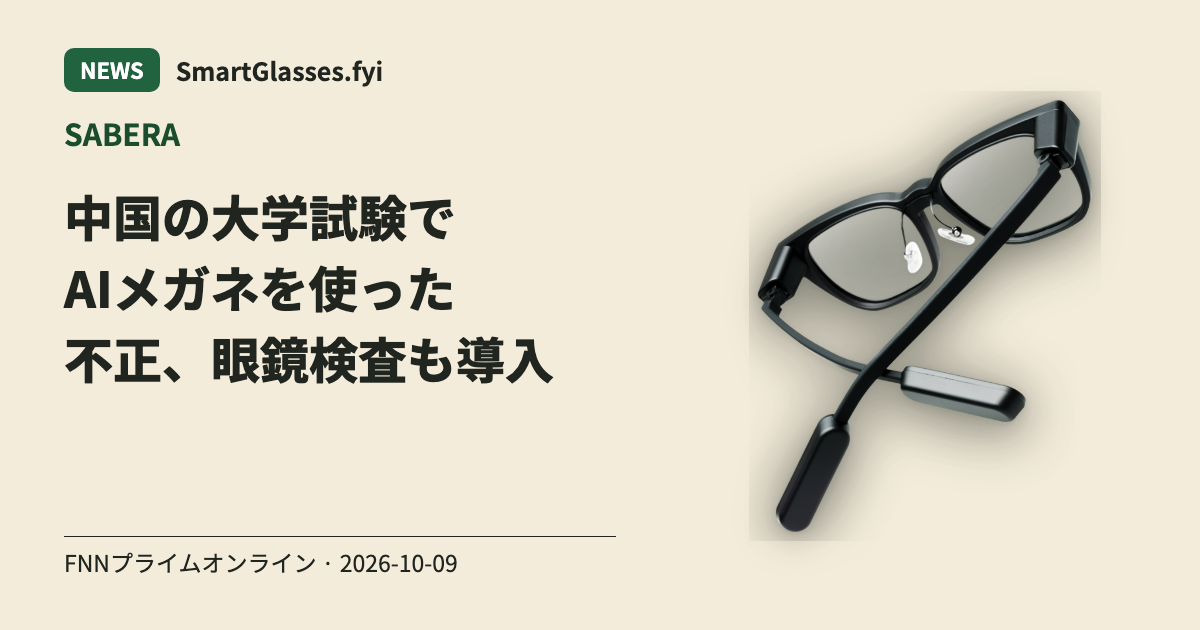
Cheating with AI glasses at a Chinese university exam; glasses inspections introduced
FNN reports students in China photographing exam questions with AI glasses and seeing answers on the lenses, with rentals spreading on shopping sites and glasses checks introduced. It also covers cases in Japan and interviews jig.jp about its camera-free SABERA.
FNN Prime Online →
Four smart glasses cheating cases in South Korean school exams. The decisive clues were a hand touching the frame and a green light
South Korea's Ministry of Education surveyed every middle and high school in the country and announced four cases of cheating with AI smart glasses in school exams. The decisive clues were a hand repeatedly touching the frame, a green light, and glasses the student did not normally wear. This article explains why clues that worked at schools, where teachers know their students, cannot be relied on in large-scale exams.
Naoki →
South Korea's CSAT smart-glasses measures. Dedicated inspectors and hands-on training at all 1,312 venues
For the Suneung on November 19, 2026, South Korea's Ministry of Education will station one dedicated smart-glasses identification officer at each of all 1,312 test sites. Judgments follow a three-step process, and the officers receive training with real devices beforehand. This article sets out the difference between South Korea, which has moved on to stationing people, and Japan, where preparations still center on the wording.
Naoki →
World smart glasses news #36: the privacy debate
A weekly digest of smart-glasses stories from September 6–12, 2026, including that week's privacy debate.
Kotauchi Sansan →
How to tell smart glasses from ordinary glasses. Six checkpoints for exam venues
The prohibitions are written into the rules of the major exams. Cases keep surfacing in country after country, yet detection still depends on a proctor's unease. This article sorts the problem into three parts and publishes the identification cues and appraisal criteria.
Naoki →
Feature: Exams and smart glasses — what South Korea's cases show Japan must prepare for
A feature that lines up, in chronological order, the smart glasses exam-cheating cases that actually happened in South Korea, and organizes the clues for telling the devices apart, the appraisal standards, and the preparation Japanese organizers can make.
Naoki →