Opinion
South Korea's exam countermeasures move past bans to detectors and budgets. The plan for 7,200 radio wave detectors and the breakdown of the 111 CSAT cases
The final tally for the CSAT was 111 cases of electronic device misconduct, and 54 of them were found through disaster alerts sent during the exam. Around the same time, South Korea lined up a budget proposal for 7,200 radio wave detectors and specialist personnel, a detector development race, a secondhand trading ban, and a presidential order to overhaul the exam system with rewards for reports. This article organizes the stage that followed bans and visual checks: equipment, budgets, and institutions.
With the CSAT (College Scholastic Ability Test) over, South Korea's exam countermeasures have moved past the stage of ban wording and proctors' eyes. A budget proposal has been prepared for national qualification exams covering 7,200 radio wave detectors and 23,559 specialist personnel, and detector development now involves both a national agency and private security companies. A secondhand trading platform designated AI glasses as a prohibited item, and the president ordered a complete overhaul of the national exam system and rewards for reports. The unit of countermeasures is shifting from rulebook clauses to equipment, budgets, and institutions.
The CSAT tally came to 111 cases. Nearly half were found through disaster alerts
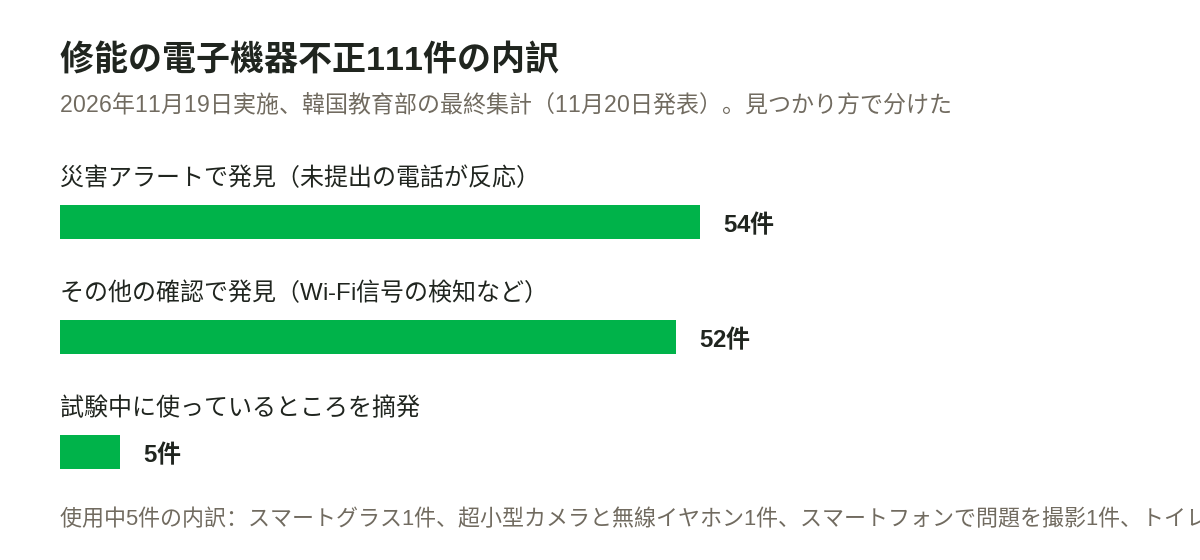
At the CSAT on November 19, the Ministry of Education announced a final tally of 111 cases of misconduct involving electronic devices. The count on the day of the exam was 98, and the final tally added 13 more.
The breakdown divides by how cases were found. In 54 cases, phones that had not been submitted responded to disaster alerts the government sent to mobile phones during the exam. Another 52 were found through other checks, including Wi-Fi signal detection. Five were caught while using a device during the exam.
The five cases were one use of smart glasses (South Chungcheong), one mini camera with a wireless earphone (Gyeonggi), one smartphone photographing exam questions (Seoul), and two uses of smartphones in exam site restrooms (Seoul and Gyeonggi).
Most of the 111 cases were possession of unsubmitted electronic devices, not use. At the CSAT, prohibited electronic devices must be submitted before the first period begins, and holding one counts as misconduct even if it is never used. The disaster alerts that found 54 cases were sent three times during the exam as an anti-cheating measure. Even before new detectors arrive at sites, existing systems and possession checks produced this many detections.
 Source imageThe CSAT electronic device tally came to 111 cases, announced by the Ministry of Education (Yonhap News) · Read the source ↗
A budget proposal covers 7,200 detectors and specialist staff for national qualification exams
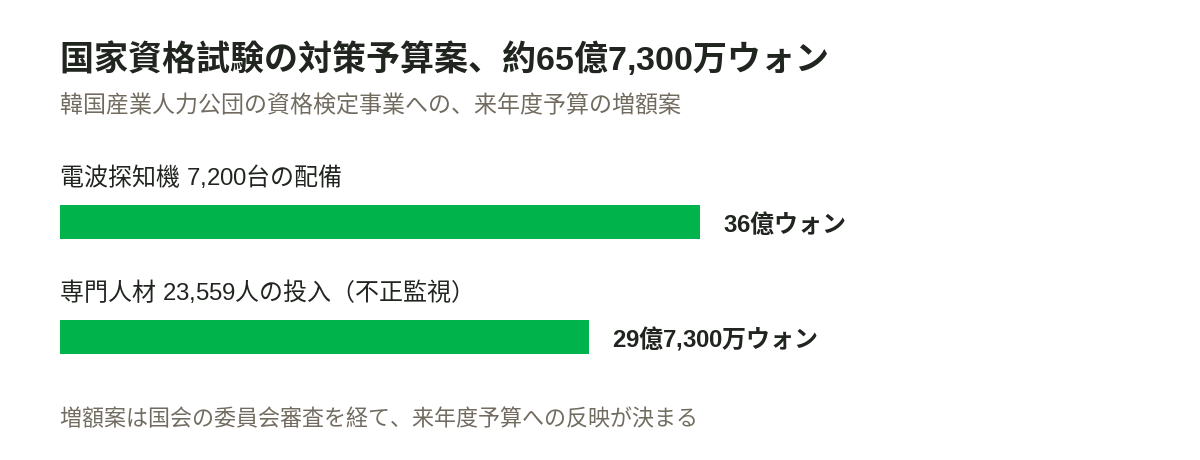
The countermeasures are not aimed at the CSAT alone. A proposal to increase next year's budget has been prepared for the qualification examination program run by the Human Resources Development Service of Korea. The total is about 6.573 billion won. The office of Rep. Kim Wi-sang of the People Power Party, a member of the National Assembly's Climate, Energy, Environment and Labor Committee, drafted the proposal from the agency's own estimate.
The proposal has two parts. Deploying 7,200 radio wave detectors gets 3.6 billion won. Assigning 23,559 specialist personnel to monitor cheating with smart glasses and similar devices gets 2.973 billion won.
The reason the agency gave is the limit of visual identification. AI smart glasses look like ordinary glasses, and exam supervisors cannot reliably tell them apart by eye. Supervision currently relies on watching examinees for suspicious behavior, and the agency says that has reached its limit. Its explanation is that exam sites need equipment that can detect wireless communication signals, along with dedicated personnel.
National qualification exams draw about 4.4 million examinees a year, and six smart glasses cases had been caught this year as of the end of October. The increase now goes through committee deliberation, which decides whether it enters next year's budget. Rep. Kim also said that even before a detection system is ready, preemptive steps are needed, such as inspecting every pair of glasses or allowing only rimless and metal frame glasses.
 Source imageAbout 6.5 billion won increase proposed for AI glasses countermeasures in national qualification exams (Yonhap News) · Read the source ↗
Detector development advances through a government tender and private competition
Development of the detectors themselves has also begun. On November 2, the Korea Communications Agency (KCA) issued a tender for commissioned development of an AI smart glasses radio wave detection device. The project budget is 50 million won, with a 70 day development period from contract. The device is a portable unit carried by proctors. It identifies the presence and maker of AI glasses from Bluetooth signals and analyzes Wi-Fi traffic patterns to infer signs of photo transmission or AI service use.
KCA has already secured detection technology able to watch over a single classroom. This development turns that technology into equipment for field use. On November 18, the agency's president said the first stage of demonstration is complete and that the goal is to apply the technology from February next year at the computer based ICT qualification exams KCA runs.
Private development is moving in parallel. K&Us is building a device that analyzes Bluetooth and Wi-Fi signals to identify people suspected of wearing smart glasses and alert proctors, and plans to complete a prototype early next year. Gison is combining signal analysis software with existing radio detection equipment, with a method that shows the location of suspicious signals through AR. It also plans a lower cost dedicated unit for fixed installation at exam sites in the first half of next year. Both companies took part in the KCA tender.
Development is expected to finish at the end of January next year at the earliest. Against the plan to deploy 7,200 units, the development project is still small in scale. Detectors reach exam sites next year. This year's exams ran on personnel assignments and systems, in that order.

Secondhand trading stopped too. AI glasses became a prohibited item
The countermeasures also moved outside exam sites. On November 16, the secondhand trading platform Bungaejangter designated AI glasses as a prohibited trading item. Words such as AI glasses, AI glasses rental, and smart glasses were registered as banned terms, blocked in both search and listings.
The platform explained that cases of AI glasses being misused for exam cheating had appeared, and that it judged the products unsuitable for secondhand trading under social norms. It named Rokid AI glasses, which carry a display in the lens and can analyze with AI, as a focus of enforcement. Mini cameras had already been a prohibited item since 2021, before this move.
The measures reached beyond stopping devices at exam sites to the channels through which they are obtained. The banned words include rentals. Not only buying, but borrowing became a target as well.

The presidential orders reached a system overhaul and cash rewards
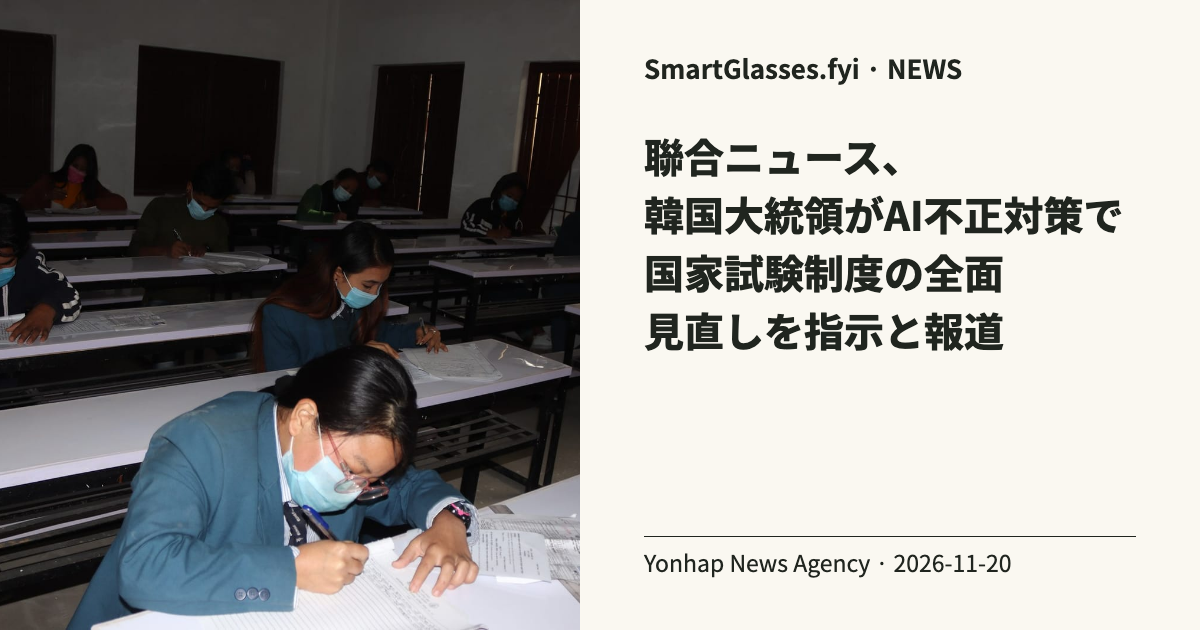
On November 20, at a meeting with his senior aides, President Lee Jae Myung ordered a complete overhaul of the national exam system as a countermeasure against AI assisted exam cheating. He also called for strict punishment of those who cheat.
On the following day, the 21st, he restated the policy of paying 100 million won per case to anyone who reports CSAT cheating. Reporting several cases together pays the reward for each case. A person who cheated, turns themselves in, and reports accomplices receives a reduced punishment while still being paid the full reward. The president positioned CSAT cheating as a crime as serious as corruption by public officials.
Sanctions are also being strengthened. In a public statement issued before the CSAT, the government said it would inspect every examinee for smart glasses in every exam period and increase exam management staff. For the eligibility restriction on those who cheat, the plan is to consult the National Assembly so that raising it from the current one year to ten years can apply from this year's CSAT.
The cost of countermeasures is now visible in numbers
Laid side by side, the moves of this past week show the structure of South Korea's countermeasures changing. Ban wording existed before. Assigning people to identify devices was carried out at the CSAT. Beyond that, detector counts, monitoring staff numbers, and a total budget are now beginning to line up.
With numbers published, organizers in Japan have more material for their own estimates. How many detectors, at what cost. How many monitoring staff, at what cost. The cost of countermeasures can be recalculated against venue counts and examinee numbers. The 111 CSAT cases also showed an order of operations. Even at sites where detectors are not yet in place, most cases were found through existing systems such as disaster alerts and through possession checks.
At the same time, detector development finishes next year, and the deployment budget is still under deliberation. What fills the gap until the equipment is ready is procedures for checking, a route for escalating uncertain judgments, and a way of keeping records. That is what South Korean sites built first.
Even with detectors in place, what happens after a suspicious signal or pair of glasses is found, how it is checked and where it is escalated, is decided by procedures at the site. Smart Glasses Lab provides this part for Japan.
- Identification manual preparation: we document, for each model, the identifying features (camera position, LED, charging port, weight, and so on), the criteria for requesting a check, and the escalation procedure for hard-to-judge cases, matched to the organizer's rules and operations
- Identification training for exam invigilators: a 90-minute training session with real devices brought in, where participants touch and confirm the identifying features themselves. As with the training of Korea's identification officers, the experience of handling the real devices supports judgment on the day
- Device appraisal: we verify the functions of the model in question and state its risk category (A, B, or C) and the grounds in writing. It serves as material for drafting the wording of the rules
The service is for exam organizers and operating bodies. Fees are quoted individually according to the content. Consultations are accepted even before the content is settled. Contact [email protected] .
Related articles
South Korea's CSAT smart-glasses measures. Dedicated inspectors and hands-on training at all 1,312 venues
For the Suneung on November 19, 2026, South Korea's Ministry of Education will station one dedicated smart-glasses identification officer at each of all 1,312 test sites. Judgments follow a three-step process, and the officers receive training with real devices beforehand. This article sets out the difference between South Korea, which has moved on to stationing people, and Japan, where preparations still center on the wording.
Naoki →
Feature: Exams and smart glasses — what South Korea's cases show Japan must prepare for
A feature that lines up, in chronological order, the smart glasses exam-cheating cases that actually happened in South Korea, and organizes the clues for telling the devices apart, the appraisal standards, and the preparation Japanese organizers can make.
Naoki →
South Korea's smart glasses bans are spreading. Inspections at exam sites, military units and companies, and the limits of telling them apart
South Korea's Ministry of National Defense has strengthened inspections of smart glasses across all military units, and since November 1 suspicious glasses have been checked by X-ray. The entry bans that began at exam sites have spread to the military and large companies. This column looks at the limits of frame thickness as a tell, and at how each site has built its checks on the assumption that the devices cannot be told apart by sight.
Naoki →
Smart-glasses cheating in South Korean exams: a roundup. National qualifications, universities, school exams, and a top scorer's confession
A chronological roundup of confirmed smart glasses cheating cases in South Korean exams in 2026. Busts in national technical qualification exams, a swap to smart glasses after entry checks in university essay exams, four cases in school exams, the tax accountant exam that ended with the top scorer turning himself in, the final CSAT tally, and the countermeasures that have since moved to detectors and budgets.
Naoki →