Opinion
Dutch privacy authority advises against buying AI camera glasses. Its study of six models found faulty recording indicators and wrong advice
On November 19, 2026, the Dutch Data Protection Authority (AP) examined six AI camera glasses models on sale and advised consumers not to buy them for general use for now. It found models that kept filming when the recording lamp was covered, a model that gave wrong advice in an emergency scenario, and models a nearby person could connect to. The model names have not been published.
On November 19, 2026, the Dutch Data Protection Authority (AP) advised consumers not to buy AI camera glasses for general use for now. In its hands-on study of six models on sale, it found models that kept filming when the recording lamp was covered, a model that gave wrong advice in a simulated emergency, and models a nearby person could connect to without permission. A privacy authority has reached the stage of testing products itself and advising against buying them.
Six models were studied. The model names have not been published
The study covered six AI camera glasses models available on the Dutch market. Two of them were tested intensively in simulated practical scenarios involving people's safety.
The AP announcement names no models or makers. Which products were studied has not been published, and the results cannot be tied to a specific product. What the announcement shows is a set of problem types found repeatedly across models.
The problems found were recording indicators, AI advice, where the data goes, and connection flaws
For filming, on almost all models the recording lamp was hard to see and easy to cover. Most models kept filming after the lamp was covered. Even a model whose maker said filming would stop if the lamp was covered kept filming. People nearby were left almost unable to tell whether they were being filmed.
In AI advice, the errors lined up in safety related scenarios. In a simulated CPR scenario, one model repeatedly answered that an ambulance was already on its way when none had been called. Another model gave dating advice in a scenario where an adult showed interest in a minor. Answers that ignored a safety warning on a toy for young children, misreadings of a medicine leaflet, and misinterpretations of a severe weather warning were also confirmed. The AP states that the glasses speak in a persuasive tone while the information is wrong, or even dangerous.
Where the data goes was also opaque. The AI functions studied processed data on external servers, many of them outside the EU. Users were not adequately shown which AI model processes their data or which companies it goes to.
On connections, several models had serious software flaws. A nearby person could connect to the glasses without permission, view recordings, and operate the camera.
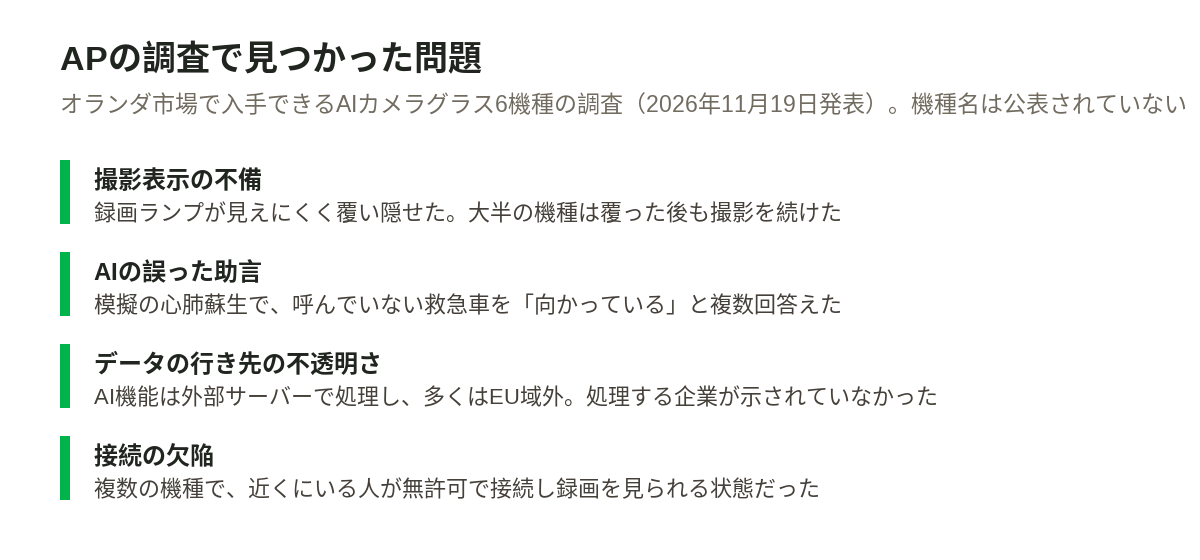 Source imageAP advises against buying AI camera glasses (Dutch Data Protection Authority) · Read the source ↗
What the authority asked makers was to make it clear by design
The AP asked developers and makers for four things. To make it unmistakably clear to people nearby that they are being filmed, and to make the recording lamp hard to hide while filming continues. To let users know where their data goes and who processes it for what purpose. To make AI advice sufficiently reliable, and certain where health and safety are involved. And to secure the product properly and be able to demonstrate compliance with European rules including the AI Act.
To venue owners and managers it advised banning the wearing and use of camera glasses in house rules, and provided standard wording for those rules. It called on Dutch and European politics to use the findings in future policy making.
This advice is not a sales ban. It covers general use, and carries the time qualifier 'for now'. The AP also recognizes that such glasses can have value, for example helping people with visual impairments understand their surroundings. What it questions is the reliability of the products at this point.
In September it had already warned that filming people nearby is almost always prohibited
In September 2026 the AP had already warned users of camera glasses that filming people nearby is almost always prohibited. Identifiable footage is personal data, and processing it requires a legal basis and notice to the person. Telling everyone in a public space in advance and obtaining consent is practically impossible, which was its reasoning.
The November study showed what comes next. The problems extended beyond privacy to the user's own safety and the products' security. The authority's moves have advanced from warnings to users, to hands-on testing of the products themselves, to design demands on makers.
Related articles
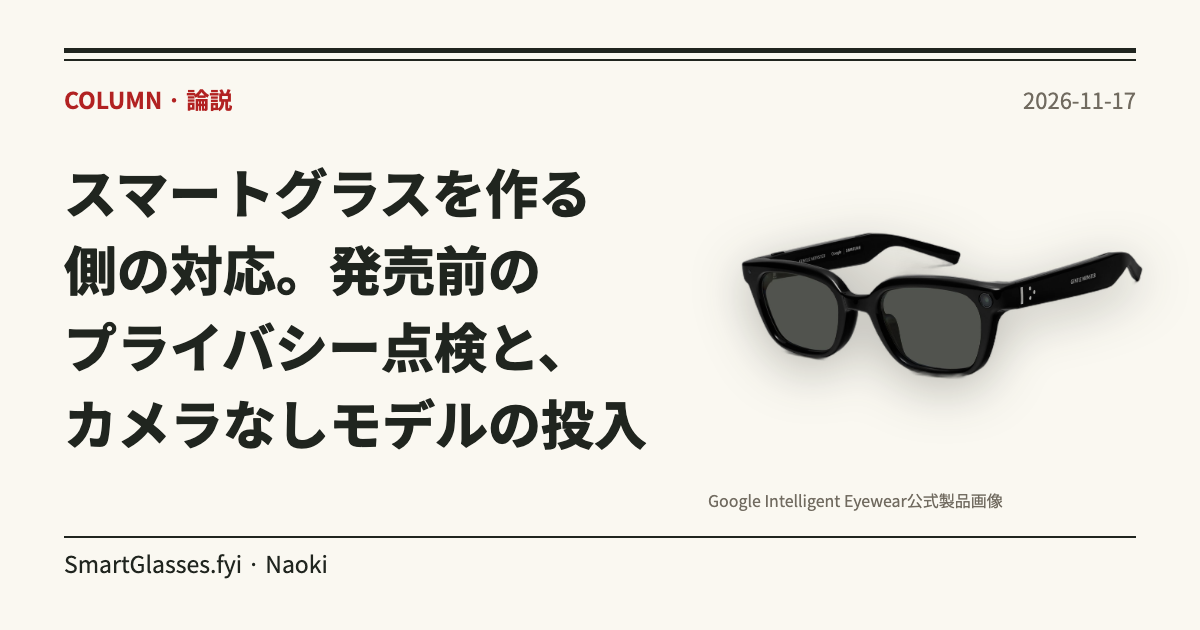
The response from the makers of smart glasses. A privacy review before launch, and a model with no camera
As the movement to stop smart glasses from being brought into exam sites and military units spreads, the makers have begun to respond. Gentle Monster ran an internal review of its privacy and security policies ahead of the Intelligent Eyewear launch, and Meta released an audio-only model with no camera. This column traces how pressure from the side doing the stopping has begun to change product design.
Naoki →
Reuters reports the Dutch privacy authority advised consumers not to buy camera AI glasses
Reuters reported that the Dutch Data Protection Authority (AP) advised consumers not to buy camera AI glasses. It examined six models sold in the country and confirmed problems including covert filming, wrong advice and security flaws.
Reuters (via 94.1 The Duke) →
Dutch authority studies six AI camera glasses models and finds faulty recording indicators
The Dutch data protection authority examined six AI camera glasses models on sale and found problems such as recording continuing when the recording lamp was hidden. It advised consumers to hold off buying them for general use.
Biometric Update →
Feature: Global smart glasses countermeasures — where the side that stops them stands
Alongside South Korea's and Japan's exam countermeasures, this feature covers Argentina's abolition of its exam, the Dutch authority's advice against buying, wearing bans at schools and venues, and sales halts, organized in four chapters: exams, regulation and sales, places, and the makers' responses.
Naoki →