Opinion
The four layers of smart glasses countermeasures. The wording of bans, identification capacity, detection technology, and exclusion from the market
The countermeasures against smart glasses, rearranged by the kind of measure. The wording of bans, identification capacity, detection technology, and exclusion from the market. Countermeasures have added a layer with each incident, and the thick layer differs by country.
The countermeasures gathered in this feature fall into four layers by the kind of measure: the wording of bans, identification capacity, detection technology, and exclusion from the market. The layers do not replace one another; a new one has been added with each incident. Which layer is thick differs by country.
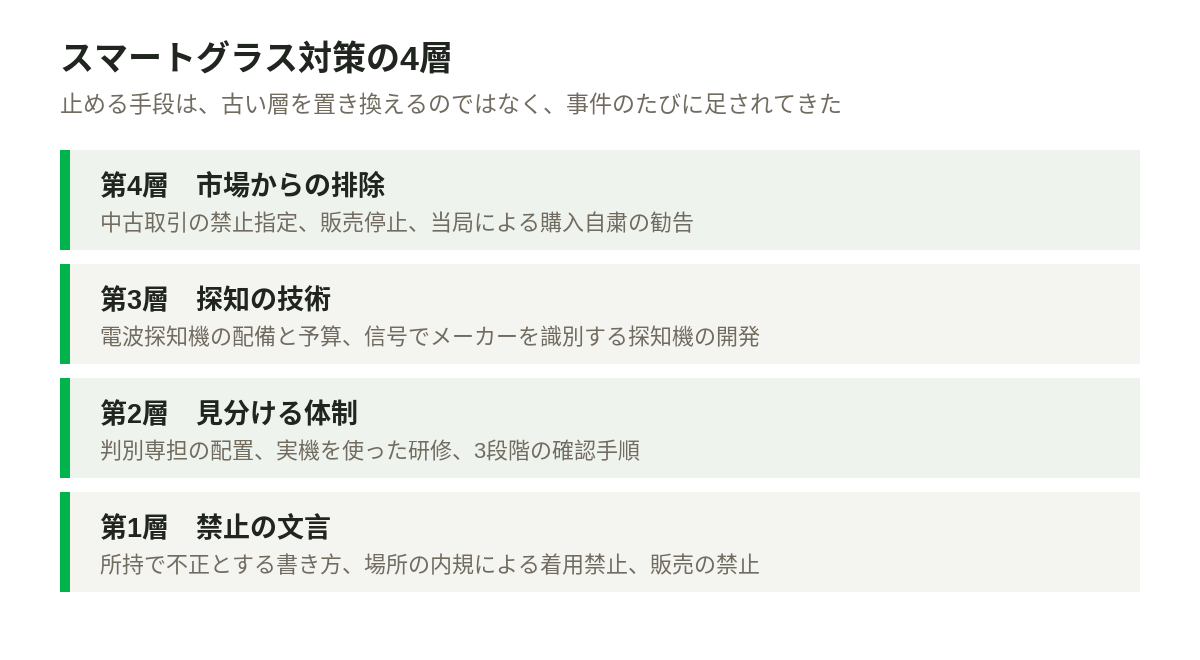
Layer one is the wording of the ban
Japan's Common Test changed its wording in the Reiwa 9 application guide: a device with communication functions that is not put away inside a bag counts as in use and as cheating, even when switched off. Pakistan's Punjab province banned the use and sale of camera smart glasses for 30 days. The Norwegian government proposed a temporary ban in public places.
The wording is the fastest layer to build, and the cheapest. Moving the basis of judgment to the state of possession removes the need to prove use. But wording alone leaves the venue with the task of judging whether a pair of glasses is a smart glasses model.
Layer two is identification capacity
South Korea placed dedicated identification officers at all 1,312 Suneung venues and had them trained with real devices. Judgment runs in three stages: the venue supervisor, the dedicated officer, and the situation room of the office of education and the ministry. In a school exam, the decisive factor in finding cheating was the eye of a teacher who knew the student's usual behaviour. In Taiwan and China too, discovery began with the awareness of someone who was there.
The capacity layer costs money for training and staff. In return, it takes on the identification work that the wording layer leaves at the venue, with procedures and numbers of people rather than attentiveness.
Layer three is detection technology
In South Korea, a budget proposal for national qualification exams covers 7,200 radio wave detectors and specialist staff, and a government agency issued a tender to develop a detector that identifies makers from Bluetooth signals. At the Suneung, 54 cases were found when unsubmitted phones reacted to a disaster alert sent during the exam. It is an example of existing systems, not new devices, producing the numbers.
Detection targets are shifting from the shape of the glasses to the signals the devices emit. This layer is the technology side's answer to the premise that smart glasses cannot be told apart from ordinary glasses by appearance. It costs more than wording or capacity, and takes time to develop and deploy.
Layer four is exclusion from the market
A major South Korean used goods marketplace designated AI glasses as a prohibited item. In the Netherlands, an eyewear chain stopped selling them and the privacy authority advised consumers not to buy. In Australia, a retailer halted online sales of camera glasses after a privacy investigation.
The market layer stops devices before they reach users' hands. Argentina's abolition of its national residency selection exam can be read as an extreme form of this layer. Rather than stopping the devices, it removed the exam that had become the stage for cheating.
The thickness of the layers differs by country
South Korea layered detection on top of wording and capacity, and touched the market layer too. In about a year, layers one through four accumulated. In Europe, privacy authorities are pushing the market layer and design demands on makers. Japan is at the point of having changed the wording.
| Country / region | Layers that thickened | Representative examples |
|---|---|---|
| South Korea | Wording, capacity, detection, market | Suneung identification officers, the budget proposal for 7,200 detectors, the used market ban designation |
| Japan | Wording | The change to the Common Test wording |
| Europe | Market and design demands | The Dutch AP's advice against buying and its four demands on makers |
| Argentina | The exam framework itself | Abolition of the national unified exam |
| Competition | Wording | The Poker TDA 2026 rules and the UCI's complete ban in track competition |
Which layer thickens has been decided by how incidents unfolded in each country. When detections continue, capacity and detection are added; when filming harms spread, the market layer moves. The map of countermeasures overlaps the map of incidents.
The same accumulation has begun on the competition side. The Poker TDA, which sets poker tournament rules, wrote into its 2026 rules that wearable devices including smart glasses, and technology usable for external assistance, are banned at the table, naming them explicitly. In casinos, Nevada's gaming regulator named Google Glass in 2013 and issued a notice encouraging operators to prohibit wearing and using it on gaming floors and during play. FIDE, the international chess federation, listed smart glasses in its 2022 anti-cheating regulations as an example of a device that may not be brought into the venue.
Cycling's UCI does not permit image devices worn by riders under its rules, and its 2026 track competition document states explicitly that smart glasses with camera and data transmission functions do not comply and are entirely prohibited. In the same year, a rider wearing camera glasses in a road race was reported to have been disqualified. India's cricket board banned the possession and use of smart sunglasses in the players' and match officials' area in 2026. Golf's rules do not name devices; they allow obtaining distance information and ban the act of interpreting that information. In competition, the wording layer stands first, with identification capacity behind it.
For exam organizers, the material is which layer their own exam is designed to stop things at. An exam with wording only leaves venue judgment to supervisors' attentiveness. South Korea's dedicated officers and training, and its detector budget proposal, show how to build the layer that takes that judgment on.
Related articles
Poker's global tournament rules name smart glasses in the 2026 edition, banning them at the table along with AI assistance
The Poker TDA, which sets the rules for poker tournaments, states in Rule 5 of its 2026 rules (September 21, 2026) that wearable devices such as smart glasses, and technology usable for external assistance, are prohibited at the table unless specifically authorized. The wording does not appear in the 2024 edition.
Poker TDA →
Feature: Global smart glasses countermeasures — where the side that stops them stands
Alongside South Korea's and Japan's exam countermeasures, this feature covers Argentina's abolition of its exam, the Dutch authority's advice against buying, wearing bans at schools and venues, and sales halts, organized in four chapters: exams, regulation and sales, places, and the makers' responses.
Naoki →
Exam countermeasures against smart glasses cheating differ by country. Japan treats possession itself as cheating on the Common Test, while South Korea posts dedicated officers and revokes passes
Japan's Common Test guidance for the Reiwa 9 academic year now treats a connected device left outside the bag as cheating in itself. South Korea relies on dedicated identification officers at venues and sanctions that include revoking passes and a five year ban. In Argentina, a retest ended with the national unified exam abolished. This column compares how each country writes the ban, what happens after a detection, and how supervision is organized.
Naoki →
South Korea's exam countermeasures move past bans to detectors and budgets. The plan for 7,200 radio wave detectors and the breakdown of the 111 CSAT cases
The final tally for the CSAT was 111 cases of electronic device misconduct, and 54 of them were found through disaster alerts sent during the exam. Around the same time, South Korea lined up a budget proposal for 7,200 radio wave detectors and specialist personnel, a detector development race, a secondhand trading ban, and a presidential order to overhaul the exam system with rewards for reports. This article organizes the stage that followed bans and visual checks: equipment, budgets, and institutions.
Naoki →
Feature: Exams and smart glasses — what South Korea's cases show Japan must prepare for
A feature that lines up, in chronological order, the smart glasses exam-cheating cases that actually happened in South Korea, and organizes the clues for telling the devices apart, the appraisal standards, and the preparation Japanese organizers can make.
Naoki →