
Opinion
How far Victoria’s schools are taking smart glasses off
Gizmodo Japan’s report on Victoria’s school ban, read alongside the state policy page. The open question is whether camera-free everyday glasses fall on the same side of the line.
How far will smart glasses be taken off at school? Gizmodo Japan has a short account from Victoria, Australia.
The reason for the ban did not read as covert filming and cheating alone. The explanation was focus on learning, and an environment parents can trust. What interests me is whether that line stops at camera glasses or reaches display-only glasses too.
What Gizmodo reported is a student ban from 2027
Gizmodo Japan reports that from 2027 Victoria will ban students from using smart glasses at public, private, and Catholic schools across the state. Education camps are included, it says.
Smart glasses shut out again: a full ban at some Australian schools (Gizmodo Japan headline)
The article quotes a press release from Education Minister Gabrielle Williams, in this Japanese rendering.
The reason for banning smart glasses is straightforward. Students should focus on learning, and parents should be able to feel that children are safe and respected in the school environment. Smart glasses should not be brought into classrooms or schools.
The same article also mentions a ban during the SAT, and school rules in Florida, Massachusetts, and Utah. It notes Australia’s strict line on social media for under-16s, and writes that the topic may come up in Japan before long. That reading felt natural to me too. If tools with a camera on the face spread, people will want to draw a line first where children are. I think that is the direction this will go.
On the state policy page, adults at government schools are covered too
Gizmodo’s article centers the ban on students. The state education department’s policy page goes a step wider for government schools.
Smart Glasses and Covert Filming Devices (Victoria Department of Education)
The page says the policy was announced on October 20, 2026, and takes effect at government schools on January 27, 2027. Smart glasses and covert filming devices are not to be worn or used on school grounds, or at school activities such as camps and excursions. Students are covered, and so are staff, parents, and visitors.
The definition is not cameras alone. The policy page describes smart glasses as devices worn as spectacles that can send, receive, store, record, or process digital information. There is an exception where they are a reasonable adjustment for a person with a disability and another approach will not do.
Dawn’s report on the 30-day Punjab order covered the use and sale of camera-enabled glasses. The period is limited. Reuters has reported market growth alongside European regulation and concern about use in schools. Even under the same word “school,” the lines are not drawn the same way yet.
Punjab govt bans use, sale of camera-enabled smart glasses for 30 days
EssilorLuxottica’s smart glasses boom runs into tougher regulatory scrutiny
Camera-free everyday glasses can fall inside the definition
My everyday pair is Even G2. There is no camera. I read notifications and translation on a small display in front of my face. One reason I chose this shape is that people nearby are less likely to wonder whether I am recording.
Apply the Victorian government-school definition as written, and glasses that receive a display also count as smart glasses. This page does not say that the absence of a camera puts them outside the rule. What the policy worries about is recording without consent, and the fact that it can look like ordinary glasses. I think that concern is fair. Whether display-only tools that do not record belong on the same shelf is a line still to be drawn.
I did not newly research Japanese school rules for this piece. As Gizmodo writes, a broad ban is not yet the center of the conversation. If it does come up, the first question I want asked is whether there is a camera. If it can record, I want consent, and places with children, kept distinct. If it is display only, the question is whether it sits beside the put-your-phone-away rule or stays as glasses. That difference changes what an everyday pair means.
I treat a pair like Rokid Glasses, with a camera in the frame, as the benchmark for capture. At school, and in places full of people you do not know, that camera is the first question. It seems likely to be shelved differently from a camera-free pair such as Even G2.
 Even G2
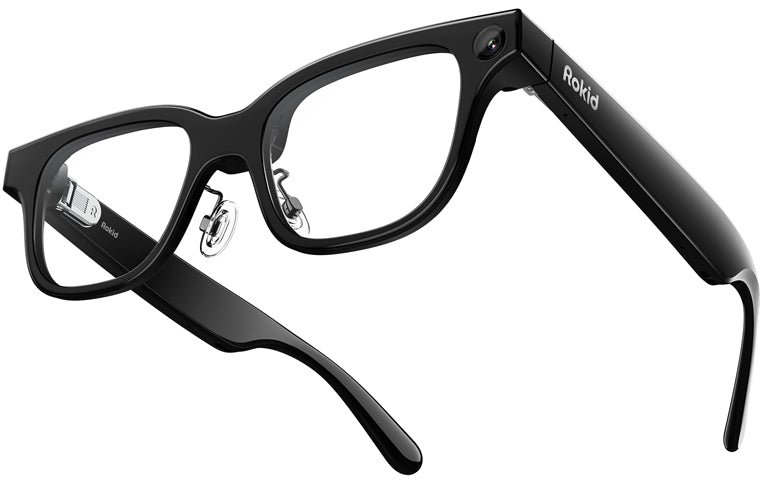 Rokid Glasses